
He COSO Cube It is a visual representation of the Integrated Internal Control Framework developed by the Committee of Sponsoring Organizations of the Treadway Commission (COSO)This model is widely used to design, implement, and evaluate internal control systems in organizations across all sectors, facilitating risk management and achieving objectives.
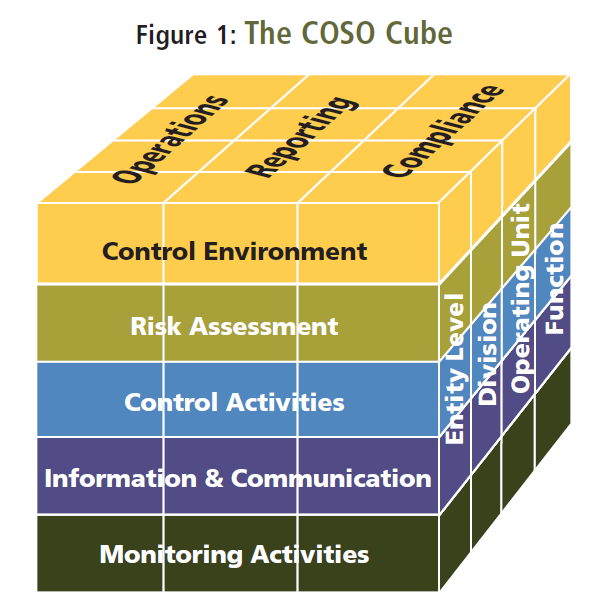
1. Structure of the COSO Cube
The cube integrates three dimensions Keys that allow us to visualize how the elements of internal control relate to each other:
A. Objectives (Upper Horizontal Axis)
They represent the goals that the organization seeks to achieve through internal control:
- Operations – Ensure that processes operate effectively and efficiently, optimizing resources.
- Financial and Non-Financial Information (Reporting) – Ensure the reliability, accuracy, and timeliness of internal and external reports.
- Compliance – Comply with applicable laws, regulations and internal policies.
B. Internal Control Components (Front Vertical Axis)
These are the five elements that must exist and function in an integrated manner:
- Control Environment – The foundation of the internal control system; it includes ethics, integrity, and organizational culture.
- Risk Assessment – Identification and analysis of relevant risks to achieve objectives.
- Control Activities – Policies, procedures and actions that mitigate risks.
- Information and Communication – Channels and systems to ensure the flow of relevant information.
- Monitoring Activities – Continuous or periodic evaluations to ensure that the internal control system remains effective.
C. Organizational Levels (Right Lateral Axis)
It shows that internal control must be applied at all levels:
- Entity – Control at a corporate or global level.
- Division or Business Unit – Control adapted to specific operating units.
- Function – Control in specific processes or activities.
2. Importance of the COSO Cube
This model allows:
- Integrate risk management throughout the organization.
- Align controls with strategic objectives.
- Evaluate the effectiveness of internal control from different perspectives.
- Facilitate internal and external audits with an internationally recognized framework.
3. Practical Application
In practice, the COSO Cube is used to:
- Design a risk map that links risks with controls and objectives.
- Assess control failures and propose improvements.
- Comply with regulations such as SOX (Sarbanes-Oxley Act), which requires evidence of internal control.
- Improve the transparency and reliability of information for investors and authorities.
4. Advantages of the COSO Model
- Comprehensive vision: covers operations, reporting and compliance.
- Flexibility: applicable in large or small, public or private companies.
- International recognition: accepted by auditors, regulators and consultants.



0 Comments